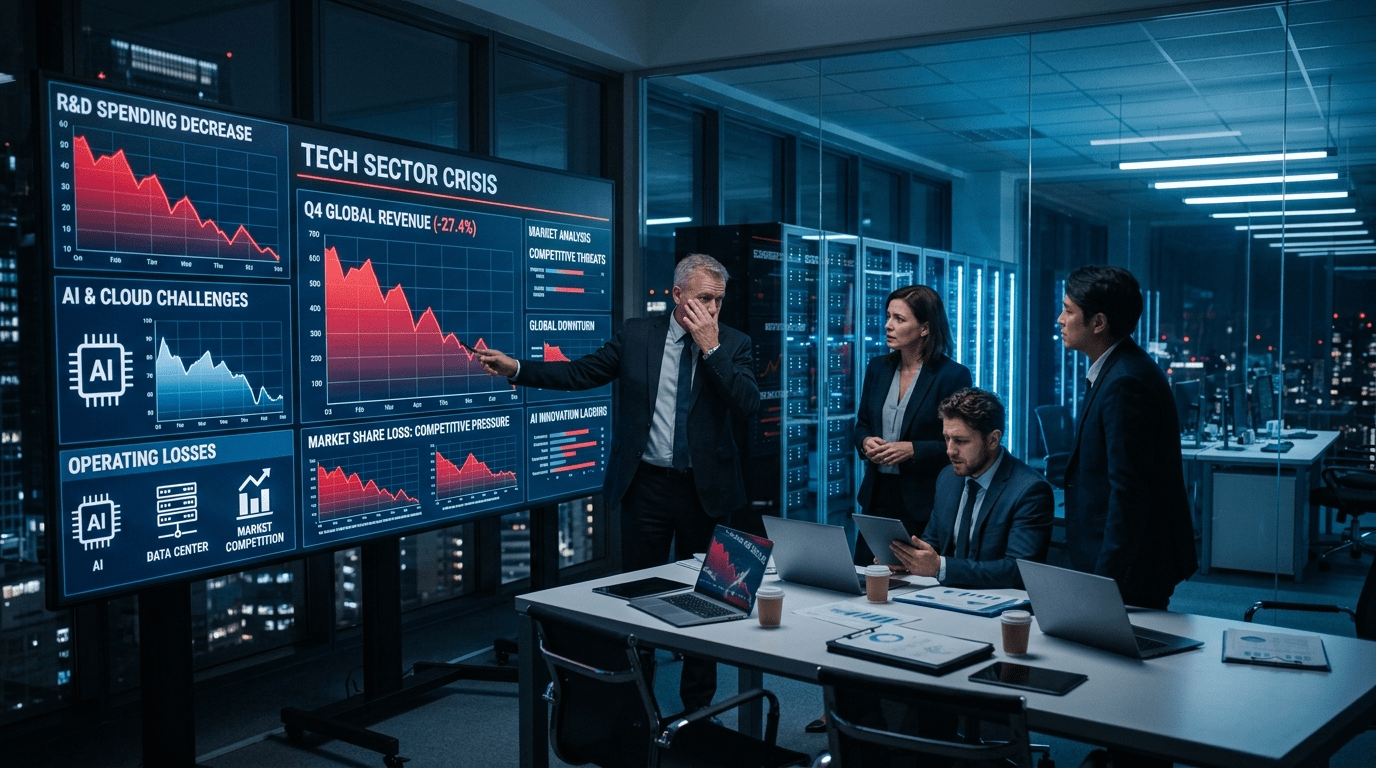
Financial Struggles Mount for ChatGPT Creator
The company behind ChatGPT is facing serious financial headwinds as it struggles to meet internal revenue projections and user growth benchmarks. CFO Sarah Fryer has reportedly warned executive colleagues that without faster revenue acceleration, the organization may struggle to cover upcoming data center expenses.
Board members have been closely scrutinizing infrastructure contracts in recent months, questioning CEO Sam Altman’s determination to aggressively expand computing capacity even as business growth shows signs of slowing.
Competition Eating Into Market Share
The competitive landscape has shifted dramatically. Google’s Gemini 3.0 launch triggered what insiders described as a “code red” alert within the company. The model leveraged proprietary tensor processing chips to quickly gain traction upon release.
Meanwhile, Anthropic’s Claude has been winning enterprise contracts, causing the ChatGPT maker to miss monthly revenue targets multiple times. User retention has also become problematic, with subscription cancellations proving difficult to manage.
Internal targets for weekly active users and annual revenue both fell short of expectations by year-end. The company had aimed to reach one billion weekly active users but failed to hit that milestone.
IPO Plans in Jeopardy
The CFO has emphasized to leadership that the company currently lacks the disciplined disclosure standards required for public markets. She expressed concerns about massive spending levels and procedural issues, suggesting the organization isn’t ready for a public listing within the year.
This conflicts with Altman’s strategy to scale the business ahead of a planned second-half IPO. The CEO maintains that securing maximum computing power is essential to eventually outpace competitors, particularly as demand for AI agents and related computational workloads surges.
The company recently secured $122 billion in funding—the largest private investment in Silicon Valley history. It’s also partnered with SoftBank chairman Masayoshi Son on the “Stargate” project, a $500 billion, five-year initiative to build AI data centers nationwide.
Profitability Remains Distant Goal
The fundamental challenge is clear: the company doesn’t expect meaningful profits until after 2030, yet lacks a proven revenue model to fund investments until then. Financial analysts project continued losses through at least that timeframe.
Some Wall Street observers worry that even if internal revenue goals are achieved, the scale of contracted data center commitments could drain all invested capital within three years. The company has never turned a profit since inception.
To cut costs, management recently paused projects including video generation service “Sora,” while launching new products like coding tool “Codex” and model “GPT-5.5.” The company also ended Microsoft’s exclusive rights to its AI models, opening distribution to Amazon Web Services and Google Cloud to boost revenue streams.
Legal Battle With Musk Intensifies
Adding to turbulence, CEO Altman is embroiled in litigation with Tesla chief Elon Musk, an early investor who co-founded the company before departing in 2018 following disagreements. Musk alleges the organization betrayed its nonprofit mission by pursuing profits after he contributed $38 million in seed funding.
The lawsuit filed in California federal court seeks damages up to $134 billion and includes demands for leadership removal. Musk has publicly called Altman a “scammer” repeatedly on social media, claiming he was deceived about developing open-source AI for humanity’s benefit.
A judge recently admonished Musk to restrain his social media habits after he posted mocking content about “Scam Altman” shortly before a hearing. Both parties attended the first court session in formal attire.
Rival Anthropic Gains Momentum
While one AI giant stumbles, competitor Anthropic—also targeting a second-half IPO—is accelerating. Founded by former insiders who left over disagreements about commercialization, Anthropic has attracted massive investment flows.
Google recently valued Anthropic at $350 billion and committed up to $40 billion in new funding. The search giant will provide 5 gigawatts of computing capacity over five years through Google Cloud, with potential for expansion.
Anthropic also raised $30 billion from BlackRock, Blackstone, Fidelity, Goldman Sachs, JPMorgan, Morgan Stanley, Sequoia Capital, and Qatar Investment Authority at a $380 billion valuation—double its worth from just months earlier.
The company made headlines with its “Claude Coworker” release, which sparked fears about software industry displacement, and later unveiled the “Mythos” model, raising concerns about potential hacking capabilities. Claude reportedly played decisive roles in recent geopolitical operations.
Broader Market Impact
Weakness in generative AI companies threatens the entire ecosystem. If profitability disappoints expectations, capital expenditures will decline, creating headwinds for semiconductor firms supplying the infrastructure.
Major tech indices already reacted negatively to the news, with significant declines across leading technology stocks including Nvidia, Amazon, Alphabet, Broadcom, Meta, Oracle, AMD, and Micron.
Upcoming earnings reports from Alphabet, Meta, Amazon, Microsoft, and Apple may face fresh scrutiny through the lens of these AI industry challenges.