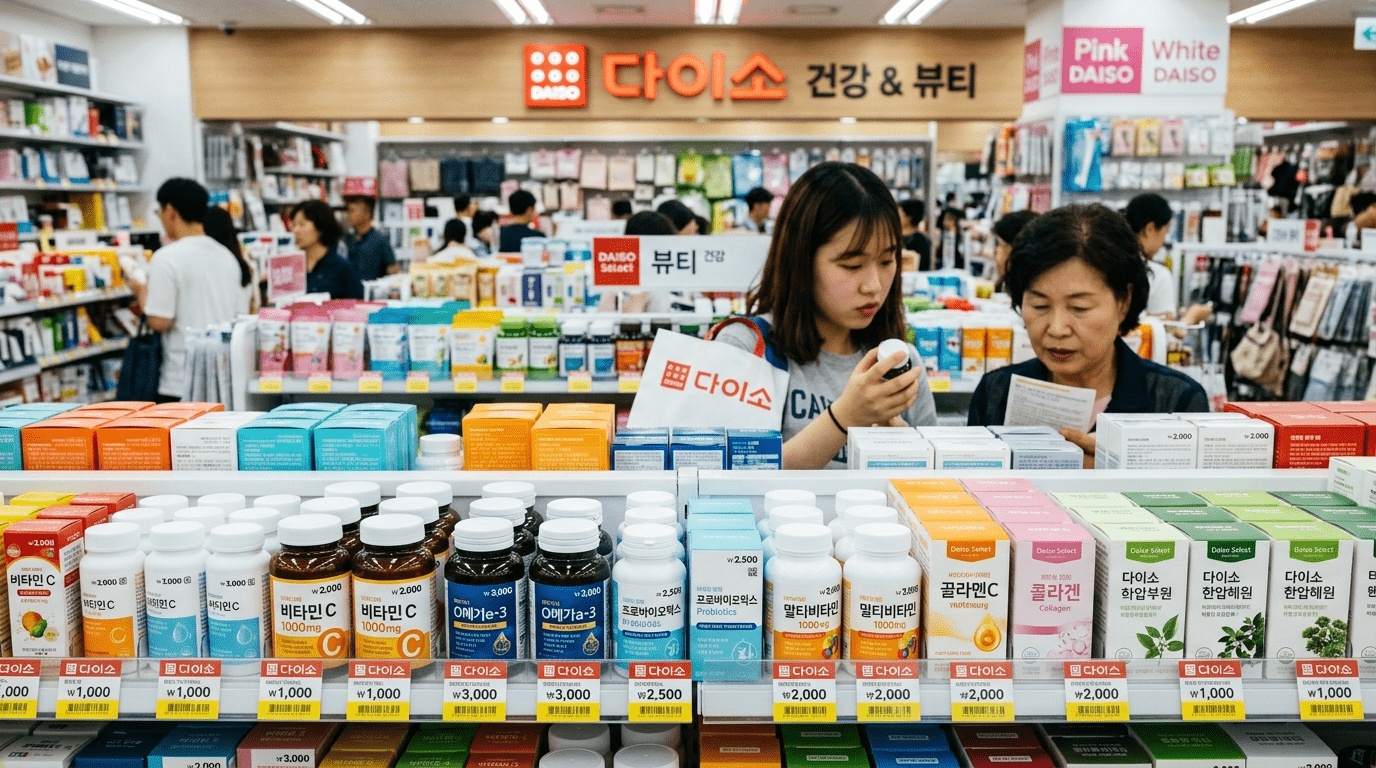
Pharmaceutical and biotech companies are increasingly turning to ultra-budget retailer Daiso as a major distribution channel, capitalizing on surging demand for affordable, high-value nutritional supplements.
Dongwha Pharm recently announced that its Daiso-exclusive product “Pyeonan Hwal” (derived from the iconic Hwalmyungsu brand, Korea’s oldest medication launched in 1897) reached the number one spot in Daiso’s food category sales. The initial stock sold out immediately after launch.
Dongwha Pharm released nine product lines at Daiso, tailored to budget-conscious shoppers seeking cost-effective options. As the variety of health products on Daiso shelves expanded, even companies that previously hesitated—wary of pharmacist backlash—began entering the market.
Yuhan Corporation, traditionally cautious about diversifying distribution, started selling probiotic products at Daiso last month. Currently, around 100 health supplement items from pharmaceutical and food companies are available at Daiso—a steep rise from roughly 30 products offered by just two firms (Daewoong Pharmaceutical and JKD Health) in March last year.
An industry source noted: “Until last year, pharmacist opposition was so intense that the Fair Trade Commission investigated the Korean Pharmacists Association for alleged unfair practices. But the atmosphere is shifting as product launches diversify.”
Breaking the Pharmacy Monopoly
For over two decades following the 2000 separation of prescribing and dispensing, pharmacies dominated pharmaceutical distribution. Companies attempting to sell “half-price vitamins” or “budget hair dye” through big-box retailers faced repeated boycott campaigns from pharmacists, their core customer base.
A landmark example: In 2011, when the Ministry of Health reclassified 48 safe products (drinks, digestive aids, ointments, patches) as over-the-counter items available at convenience stores and supermarkets, pharmacists protested fiercely. Bacchus, a bestselling energy drink from Dong-A Pharmaceutical, faced calls for “pharmacy expulsion.” The company responded by splitting the line into pharmacy-exclusive “Bacchus D” (higher taurine) and retail “Bacchus F.”
In 2014, Korea Eundan introduced vitamin C products at discount chain E-Mart, priced 30% below pharmacy rates. Despite selling over 50,000 units in two weeks, pharmacists accused the company of using “cheap Chinese ingredients” harmful to consumers. The controversy ended with a public apology.
Pharmacists’ sensitivity stems from their revenue structure. Income from dispensing prescription drugs (with fixed prices and dispensing fees) grows slowly and depends on nearby clinics. Pharmacists rely on over-the-counter sales and supplements bought by customers visiting for prescriptions. Expanding external channels threatens this supplementary income.
A Changing Landscape
Under Korean pharmacy law, nearly all medications (except designated safe drugs) can only be sold at pharmacies—blocking innovation. In the U.S., companies like Eli Lilly and Novo Nordisk sell products, including “half-price obesity drugs,” directly through their own online platforms. In Korea, even promoting a company-owned sales site remains taboo.
Daiso initially faced strong resistance. Last March, Ilyang Pharmaceutical canceled a planned Daiso launch just five days after announcing it, fearing a pharmacist boycott.
Yet the unwritten rule is crumbling. Consumer pushback against pharmacist privileges has intensified, and demand for value-driven products continues climbing. The era of pharmacies as the sole pharmaceutical platform is drawing to a close.